Unix Time vs ISO 8601: When to Use Which?
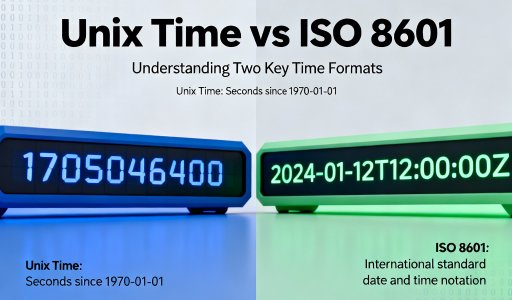
Anyone who has built software has faced the decision of whether to store timestamps as 1738756800 or as 2026-02-05T12:00:00Z. While this choice may seem minor, it significantly impacts performance, debugging, interoperability, and long-term maintainability. This post examines both formats, compares their advantages and disadvantages, and provides practical guidance on when to use each.
Unix Time Format
Unix time was introduced with the early Unix operating system and has become a standard internal representation of time in computing. It is a simple, continuous numeric value without time zones, formatting ambiguities, or string parsing. The value 0 represents midnight on January 1, 1970 UTC; negative values indicate dates before this epoch, and the number increases from that point.
Most programming languages and operating systems natively support Unix timestamps. For example, C’s time() returns it directly, Python’s time.time() returns a floating-point Unix timestamp, and JavaScript’s Date.now() returns the number of milliseconds since the epoch. Unix time is the standard for machine-oriented timekeeping.
ISO 8601 Format
ISO 8601 is an international standard for representing dates and times as human-readable strings. Its most common form looks like 2026-02-05T12:00:00Z, where the date components are separated by hyphens, the time components by colons, the letter T separates the date from the time, and the trailing Z denotes UTC (Zulu time). The standard also supports time zone offsets such as +05:30 or -04:00, date-only representations like 2026-02-05, week dates, ordinal dates, and duration expressions.
The International Organization for Standardization first published the format in 1988, with several subsequent revisions. Its design ensures clarity and lexicographic sortability. Sorting ISO 8601 strings alphabetically yields chronological order, a valuable property often overlooked.
ISO 8601 is the default or recommended timestamp format in JSON APIs, XML documents, the HTML5 <time> element, SQL TIMESTAMP WITH TIME ZONE literals, and many web standards defined by the IETF and W3C. Dates in REST API responses are typically presented in an ISO 8601 variant.
The Case for Unix Time
Unix time’s main advantage is computational efficiency. Integers are among the most efficient data types for computers. Comparing or calculating differences between timestamps requires only basic arithmetic. Sorting large volumes of timestamps is straightforward for modern CPUs. There is no need for parsing, regular expressions, or locale-dependent interpretation.
Storage efficiency is another key benefit. A 32-bit integer uses 4 bytes, and a 64-bit integer uses 8 bytes. In contrast, the string 2026-02-05T12:00:00Z requires 20 bytes in ASCII, with longer representations possible if fractional seconds or time zone offsets are included. In large databases or high-throughput systems, these differences scale significantly. Smaller payloads reduce memory, disk I/O, and network bandwidth, and improve serialization speed.
Unix time is inherently unambiguous with respect to time zones, as it is always defined relative to UTC. This eliminates the risk of misinterpretation common with naive datetime strings. Unlike some ISO 8601 strings that omit the timezone designator, Unix timestamps do not represent local time without context, reducing the likelihood of related production errors.
Unix time is also highly portable across programming languages and systems. All mainstream languages can process integers without requiring date-parsing libraries, format string agreements, or concerns about date-time separators.
The Case for ISO 8601
ISO 8601’s primary advantage is human readability. For example, 2026-02-05T12:00:00Z conveys information immediately, while 1738756800 requires conversion. Readable timestamps significantly aid debugging, auditing, and operational visibility.
ISO 8601 also provides richer semantic information. It can express time zone offsets, which are essential for applications where local time is important, such as scheduling, calendaring, legal, and financial systems. Unix time reduces all timestamps to a single UTC-relative value, losing local-time context unless stored separately.
Lexicographic sortability is another practical strength of ISO 8601. In databases, file systems, and spreadsheets, ISO 8601 strings sort chronologically without transformation. This is useful for partitioning, range queries, and contexts where data is inspected or manipulated as plain text.
Interoperability is a major advantage of ISO 8601. The JSON ecosystem, despite lacking a native date type, has adopted ISO 8601 strings as the standard for timestamp serialization. Public APIs and third-party integrations typically use ISO 8601, and deviating from this convention can lead to integration issues.
ISO 8601 also addresses edge cases that are challenging for Unix time. It can represent dates before the Unix epoch without negative numbers, express calendar dates without a time component, and natively represent durations and intervals, such as P3Y6M4DT12H30M5S. These features are important in fields like healthcare, finance, and law.
Common Pitfalls With Each Format
Both formats have potential pitfalls. Unix time’s most notable issue is the Year 2038 problem: systems using signed 32-bit integers will overflow on January 19, 2038, at 03:14:07 UTC. While 64-bit systems have addressed this for new software, legacy systems and databases with 32-bit columns remain at risk. When using Unix time, ensure storage uses 64-bit integers.
Precision is another concern with Unix time. The standard seconds-since-epoch format does not support sub-second precision, so some systems use milliseconds, microseconds, or nanoseconds instead. However, there is no universal convention, and mismatched assumptions about precision can cause significant errors in distributed systems.
ISO 8601’s flexibility can also be a drawback. The standard allows multiple valid representations for the same moment, such as 2026-02-05T12:00:00Z and 2026-02-05T12:00:00+00:00. As a result, naive string comparisons may yield incorrect results if formats or offsets differ. Proper comparison requires parsing timestamps into a canonical form.
A particularly problematic case is the “timezone-naive” ISO 8601 string, such as 2026-02-05T12:00:00 without a Z or offset. While technically valid, it is ambiguous regarding the intended time zone. This ambiguity has caused production issues in organizations of all sizes.
When to Use Unix Time
Unix time is preferable when the primary consumers of data are machines. It is well-suited for high-frequency event processing, metrics pipelines, internal microservice communication, database columns used for range queries and arithmetic, and scenarios where storage or bandwidth efficiency is critical.
Unix time is also a strong default for internal storage in applications requiring frequent date arithmetic. Calculating time differences is a simple subtraction, while ISO 8601 strings require parsing and additional processing. In performance-sensitive code, this distinction can be significant.
For systems where correctness at scale is more important than developer convenience, such as distributed databases, blockchain timestamps, or real-time bidding systems, Unix time’s simplicity and clarity make it a reliable choice.
When to Use ISO 8601
ISO 8601 is preferable when humans interact with the data. Log files, audit trails, API responses, configuration files, user-facing exports, and any context requiring manual inspection benefit from its clarity.
It is also the preferred choice for public-facing APIs, as it is the established convention and reduces cognitive load for API consumers. Developers can immediately interpret “created_at”: “2026-02-05T12:00:00Z” without additional documentation, unlike “created_at”: 1738756800.
In domains where local time semantics are important, such as scheduling, calendaring, legal compliance, financial reporting, and healthcare, ISO 8601’s support for time zone offsets is highly valuable. For example, storing 2026-02-05T17:30:00+05:30 preserves the local context, which Unix time does not.
ISO 8601 is also generally preferred in data interchange formats such as JSON, XML, and CSV, as these are often reviewed by humans during development, debugging, and analysis. Its readability provides long-term benefits.
The Pragmatic Approach: Use Both
In practice, many well-designed systems use both formats where appropriate. A common approach is to store timestamps internally as Unix time (using 64-bit integers) for performance and compactness, and to serialize them as ISO 8601 strings at the API boundary for readability and interoperability. Most modern web frameworks and ORMs support this pattern with minimal configuration, allowing automatic conversion between numeric and ISO 8601 representations.
This hybrid approach offers both fast comparisons and compact storage internally, along with human-readable, standards-compliant representations externally. For most applications, the conversion cost is negligible.
When selecting a format, be explicit and consistent. Document whether Unix timestamps are in seconds, milliseconds, or microseconds. If using ISO 8601, always include the timezone designator and avoid producing timezone-naive strings. Establish conventions early and enforce them through shared serialization libraries.
Conclusion
The choice between Unix time and ISO 8601 depends on context. Unix time is optimized for computation, storage efficiency, and unambiguous UTC representation. ISO 8601 is optimized for readability, semantic richness, and interoperability. Neither format is universally superior; effective engineers select the appropriate tool for each system layer. When deciding between integer and string formats, the recommended approach is to use integers in the database, strings in the API, and a reliable conversion layer between them.